
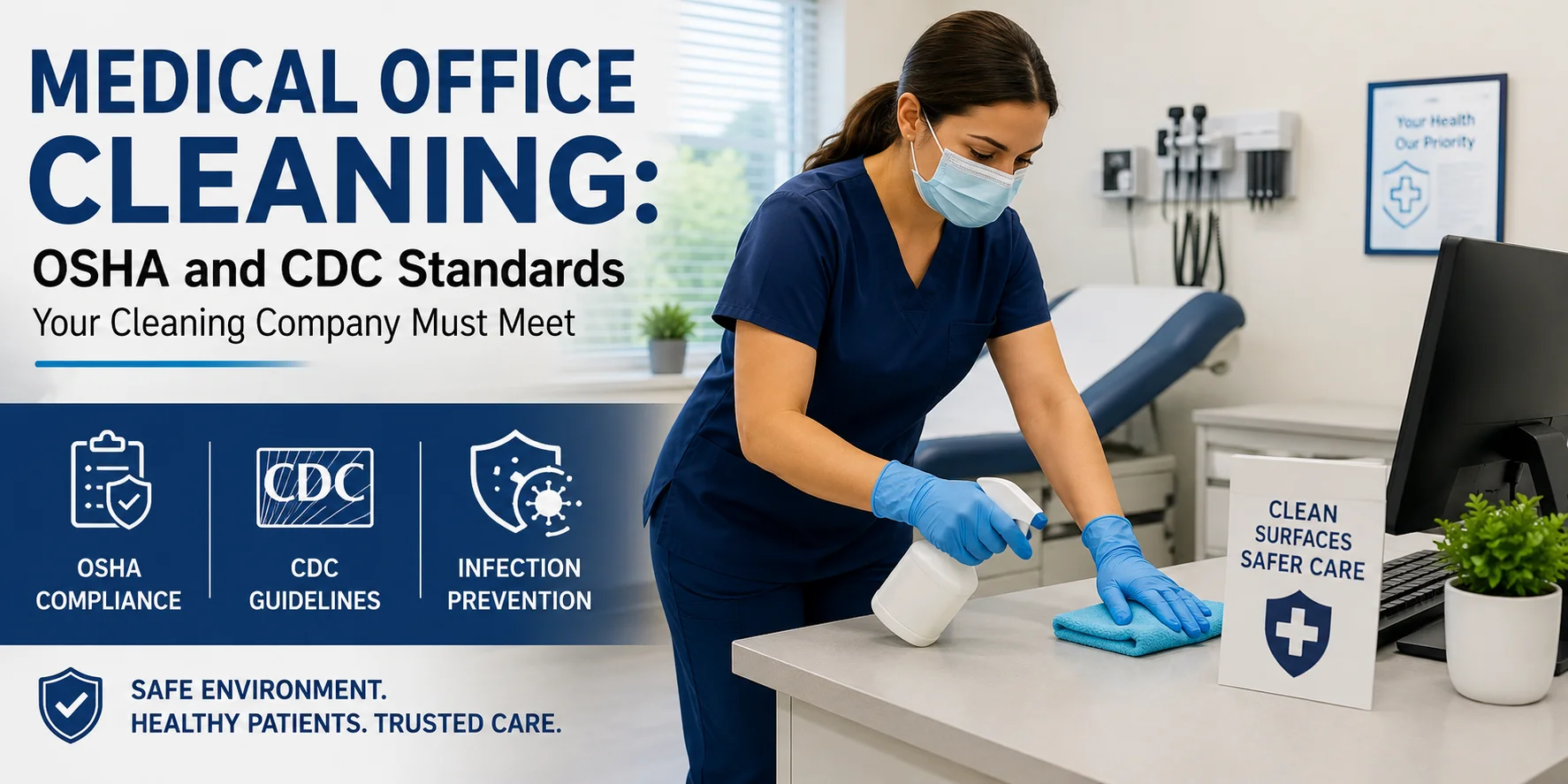
Quick Answer: Medical office cleaning is the routine cleaning and disinfection of healthcare facilities using procedures that support infection prevention. Professional cleaning typically includes disinfecting high-touch surfaces, sanitizing exam rooms, cleaning restrooms, maintaining waiting areas, handling waste appropriately, and following established healthcare cleaning practices. Facilities should align their cleaning programs with current guidance from OSHA and CDC where applicable.
Medical office cleaning requires strict adherence to OSHA Bloodborne Pathogens Standard and CDC Infection Control Guidelines. Your cleaning company must use EPA-approved hospital-grade disinfectants, follow color-coded cleaning systems to prevent cross-contamination, and train staff on biohazard waste disposal. Failure to comply can result in fines, liability risks, and contract loss. Key requirements include proper PPE use (gloves, masks, eye protection), cleaning high-touch surfaces (door handles, light switches, exam tables), and following a top-to-bottom, clean-to-dirty sequence.
The stakes are real. OSHA serious violations now carry fines up to $16,550 per violation in 2026, and willful or repeat violations can exceed $165,000. Beyond the fines, a cleaning company that fails a compliance audit risks liability claims and loses the contract outright.
What’s Included?
| Cleaning Task | Typical Inclusion |
|---|---|
| Exam Room Cleaning | ✔ |
| Waiting Room Cleaning | ✔ |
| Reception Area | ✔ |
| Restroom Sanitizing | ✔ |
| Floor Cleaning | ✔ |
| High-Touch Surface Disinfection | ✔ |
| Trash Removal | ✔ |
| Breakroom Cleaning | ✔ |
| Glass Cleaning | Optional |
| Carpet Cleaning | Scheduled |
Why OSHA and CDC Standards Matter in Medical Office Cleaning
Healthcare cleaning programs often use OSHA workplace safety requirements and CDC infection prevention guidance to help reduce risks to patients, staff, and visitors. These resources support safe cleaning procedures, proper use of disinfectants, personal protective equipment (PPE), and exposure control practices where applicable.
| Framework | What It Covers | Who Enforces It |
| OSHA Bloodborne Pathogens Standard (29 CFR 1910.1030) | Worker exposure to blood and bodily fluids, PPE requirements, exposure control plans, biohazard waste handling, employee training and documentation | U.S. Department of Labor — OSHA |
| CDC Environmental Infection Control Guidelines | Disinfection protocols, surface cleaning frequency, hospital-grade product standards, cross-contamination prevention, healthcare facility hygiene practices | Centers for Disease Control and Prevention (advisory, adopted into facility policy and state health codes) |
Why Medical Offices Need Professional Cleaning
Medical offices experience frequent patient traffic and repeated contact with shared surfaces. Professional cleaning helps maintain a hygienic environment, supports infection prevention efforts, improves patient confidence, and helps protect employees and visitors.
What Happens When a Cleaning Company Fails to Comply
Non-compliance is not a paperwork issue. It carries real financial and legal consequences:
- Fines. OSHA serious violations carry penalties up to $16,550 per violation in 2026, with willful or repeat violations reaching over $165,000.
- Liability. If a patient or staff member is exposed to a pathogen due to improper cleaning, the cleaning company can face direct liability claims.
- Contract loss. Most medical practices conduct periodic compliance audits. A cleaning company that fails one is typically terminated immediately, regardless of how long the relationship has lasted.
| The Real Cost of Cutting Corners: A single missed compliance requirement can cost a cleaning company far more than the value of the contract itself. Medical office cleaning is not a place to use standard commercial cleaning shortcuts. |
10 OSHA and CDC Requirements Every Medical Office Cleaning Company Must Meet
These are the non-negotiable standards that separate a compliant medical cleaning operation from a company that is exposing itself, and its client, to serious risk.
1. Understand OSHA and CDC Requirements Before Taking the Contract
Every technician assigned to a medical facility needs working knowledge of the OSHA Bloodborne Pathogens Standard and CDC infection control basics, including how biohazardous waste must be handled and disposed of. This is not optional reading. It is the foundation everything else is built on.
2. Use EPA-Approved Hospital-Grade Disinfectants
Standard all-purpose cleaners are not sufficient in a medical setting. Every disinfectant used must appear on the EPA’s registered list and be proven effective against the specific pathogens relevant to healthcare environments, including bloodborne pathogens and common healthcare-associated infections.
3. Prevent Cross-Contamination With a Structured System
Cross-contamination is one of the most common compliance failures in medical cleaning. The fix is procedural: use color-coded microfiber cloths and mop heads dedicated to specific room types, and always clean from the cleanest area of a room toward the dirtiest.
4. Proper Use of Personal Protective Equipment (PPE)
Cleaning staff working in medical environments need the right PPE for the task, every time. At minimum, this includes:
- Disposable gloves, changed between rooms and immediately if torn or contaminated
- Face masks, particularly when cleaning areas with airborne exposure risk
- Eye protection, when handling disinfectants or working near potential splash hazards
- Gowns or protective clothing, for higher-risk areas such as procedure rooms
5. Focus on High-Touch Surfaces
High-touch surfaces carry the highest risk of pathogen transfer and require disinfection on every cleaning visit, not just a wipe-down.
| High-Touch Surface | Why It Matters |
| Door handles and push plates | Touched by every patient, visitor, and staff member entering or exiting a room |
| Light switches | Frequently touched, rarely cleaned in standard commercial cleaning routines |
| Exam tables | Direct patient contact surface, must be disinfected between every patient |
| Waiting room arm rests | High patient contact, often overlooked in general cleaning passes |
| Reception counters and pens | Shared by every patient checking in or out |
6. Proper Handling of Biohazard Waste
Sharps, used gloves, contaminated gauze, and any material exposed to blood or bodily fluids must be handled as regulated medical waste, not standard trash. This includes using designated biohazard containers, following proper disposal protocols, and never mixing biohazard waste with general office waste.
7. Use a Color-Coded Cleaning System
A color-coded cleaning system is one of the simplest and most effective tools for preventing cross-contamination. A typical setup assigns:
- Green — reception and waiting areas
- Yellow — exam rooms and patient care areas
- Red — restrooms
Cloths and mop heads assigned to one color zone are never used in another. This single procedural rule prevents the majority of cross-contamination incidents in medical cleaning.
8. Clean Exam Rooms After Every Patient Use
Exam rooms are not cleaned on a daily schedule the way a typical office is. Every surface a patient or provider may have touched, including the exam table, countertops, and any equipment surfaces, must be disinfected between patients, not just at the end of the day.
9. Always Clean From Cleanest to Dirtiest
The correct cleaning sequence in any medical facility moves from the cleanest areas to the dirtiest: reception and waiting areas first, exam rooms next, and restrooms last. This sequence, combined with the color-coded system, is one of the core CDC-recommended practices for preventing the spread of pathogens through cleaning equipment itself.
10. Follow Strict Glove Use Protocol
Gloves must be changed between every room, never reused after handling biohazard waste, and never worn while walking through hallways or common areas between rooms. Wearing the same pair of gloves from room to room is one of the fastest ways to spread contamination across an entire facility.
Medical Office Cleaning Checklist (OSHA and CDC Compliant)
This is the baseline checklist every medical office cleaning visit should follow. Frequency and standard are listed for each area.
| Area | Cleaning Task | Frequency | Standard |
| Waiting area | Disinfect chairs, tables, surfaces | Daily | EPA-registered disinfectant |
| Reception counter | Disinfect counter, phones, pens, keyboards | Daily, multiple passes | EPA-registered disinfectant |
| Exam rooms | Full disinfection of all surfaces, table | After each patient | Hospital-grade, color-coded |
| Restrooms | Full sanitation, restock supplies | Daily, multiple passes | EPA-registered disinfectant, red zone |
| Door handles | Wipe down and disinfect | Daily, high-touch focus | EPA-registered disinfectant |
| Light switches | Wipe down and disinfect | Daily | EPA-registered disinfectant |
| Floors | Sweep, mop, disinfect as needed | Daily | Hospital-grade floor disinfectant |
| Biohazard waste | Remove and replace per protocol | Daily or as generated | Regulated medical waste handling |
| Documentation Matters: Keep a dated cleaning log for every visit, including which areas were serviced and which products were used. In a compliance audit or inspection, documentation is often the difference between a passed review and a citation. |
What Your Cleaning Company Must Provide
Whether you are a medical office manager vetting a cleaning vendor, or a cleaning company preparing to bid on a healthcare contract, here is exactly what needs to be in place.
| Requirement | Proof You Should Ask For |
| Staff training in OSHA compliance | Documented OSHA Bloodborne Pathogens training records for every technician assigned to the facility |
| CDC infection control training | Documented training on CDC-aligned cleaning protocols and cross-contamination prevention |
| Hospital-grade disinfectants | EPA registration numbers for all products used, available on request |
| PPE supplies | Confirmation that gloves, masks, eye protection, and gowns are standard issue, not optional |
| Color-coded cleaning system | Physical color-coded microfiber cloths and mop heads in use, not just a written policy |
| Biohazard waste protocols | A documented procedure for handling and disposing of regulated medical waste |
| K and K Cleaning Contractor trains every technician assigned to medical accounts in OSHA Bloodborne Pathogens compliance and CDC-aligned infection control practices. We use EPA-registered, hospital-grade disinfectants and a strict color-coded system on every medical office account we service. |
Medical vs. Standard Office Cleaning: Key Differences
A cleaning company that only has experience with standard commercial offices is not automatically equipped to clean a medical facility. Here is what actually changes.
| Factor | Standard Office Cleaning | Medical Office Cleaning |
| Disinfectant | General-purpose cleaning products | EPA-registered, hospital-grade disinfectants |
| Staff training | Basic cleaning procedures | OSHA Bloodborne Pathogens + CDC infection control training |
| PPE required | Minimal, often just gloves | Gloves, masks, eye protection, gowns as needed |
| Cross-contamination | Generally low concern | High concern, requires color-coded systems |
| Biohazard waste | Not applicable | Regulated handling and disposal protocols required |
| Cleaning frequency | Daily or scheduled | Daily, plus after-each-patient disinfection in exam rooms |
| Compliance risk | Low regulatory exposure | Federal OSHA and CDC compliance exposure |
How to Choose a Medical Office Cleaning Company
- Healthcare cleaning experience
- Trained staff
- Appropriate disinfectant use
- Reliable quality control
- Flexible scheduling
- Insurance coverage
- Positive commercial references
- Written cleaning procedures
Our commercial cleaning team understands the unique requirements of healthcare environments. We develop customized cleaning programs for medical offices, focusing on consistency, attention to detail, and established cleaning procedures that support a clean, professional facility.
Frequently Asked Questions
Is medical office cleaning different from regular office cleaning?
Yes. Medical office cleaning follows more rigorous cleaning and disinfection procedures because healthcare facilities have greater exposure to patients and frequently touched surfaces.
What disinfectant should medical offices use?
Medical offices should use EPA-approved, hospital-grade disinfectants that are registered as effective against the specific pathogens relevant to healthcare settings. General-purpose, consumer-grade cleaning products are not sufficient for medical environments.
How often should exam rooms be cleaned?
Exam rooms must be disinfected after each patient use, not just once at the end of the day. This includes the exam table, countertops, and any surface a patient or provider may have touched during the visit.
What is the OSHA Bloodborne Pathogens Standard?
The OSHA Bloodborne Pathogens Standard (29 CFR 1910.1030) is a federal regulation that requires employers, including cleaning companies, to train workers on safely handling blood and bodily fluids, provide proper PPE, maintain a written exposure control plan, and follow specific protocols for disposing of biohazardous waste.
Why are color-coded cleaning cloths used in medical offices?
Color-coded cloths and mop heads are assigned to specific room types, such as exam rooms, restrooms, and reception areas, so that cleaning tools never cross between zones. This is one of the most effective and widely recommended methods for preventing cross-contamination in healthcare environments.
What PPE is required for medical office cleaning?
At minimum, cleaning staff working in medical facilities should wear disposable gloves, face masks, and eye protection. Gowns or additional protective clothing are required for higher-risk areas such as procedure rooms or when handling biohazardous materials.
| Need Medical Office Cleaning You Can Trust? K and K Cleaning Contractor provides OSHA and CDC-compliant medical office cleaning across Michigan. Our crews are trained in bloodborne pathogen protocols, use EPA-registered hospital-grade disinfectants, and follow documented infection control procedures on every visit. Call (269) 348-3422 for a free compliance walkthrough and quote |
Related Guides
- 7 Signs Your Business Needs Professional Commercial Janitorial Services — Evaluate any contractor before you sign
- Commercial Cleaning vs. Residential Cleaning: What’s the Difference? — Why the two services are not interchangeable
- 10 Proven Benefits of Commercial Office Cleaning — Phases, pricing, and what to expect.
