
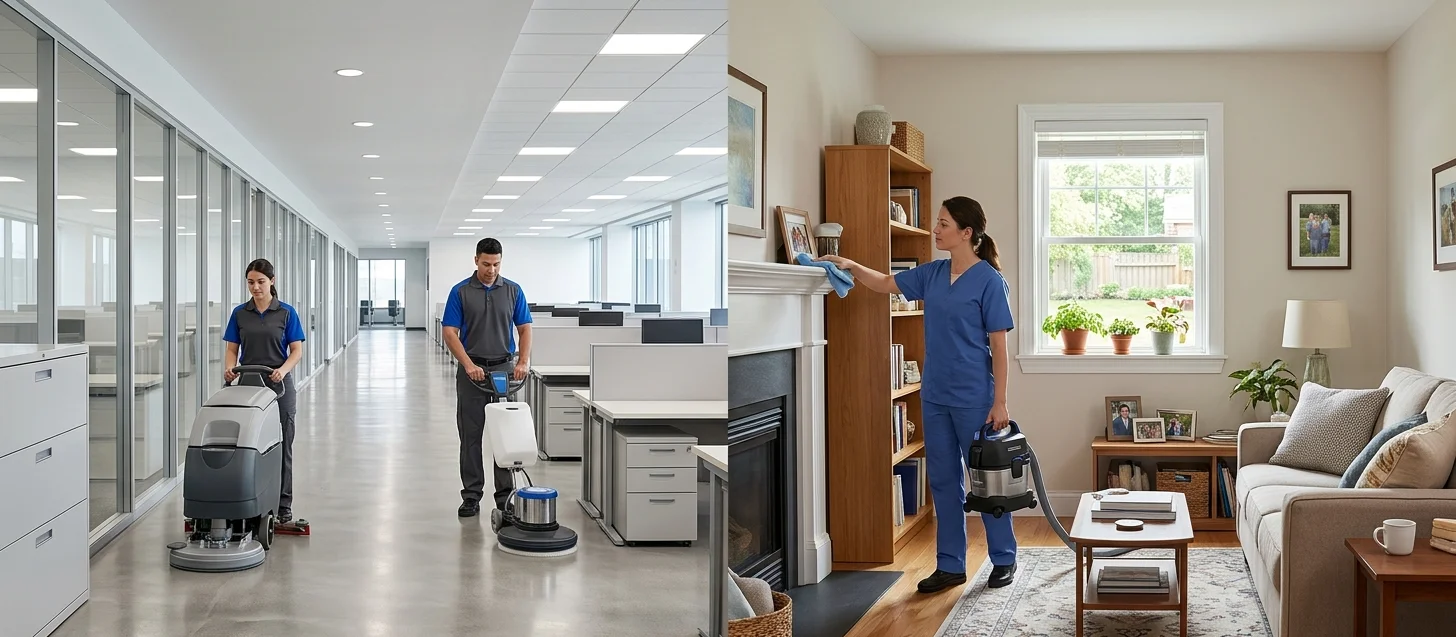
If you have ever typed “commercial cleaning near me” into Google and ended up on the website of a company that mostly cleans houses, you already know the problem. Commercial cleaning and residential cleaning are not the same thing. They are two entirely different services, built for two entirely different environments, and mixing them up can leave your business with substandard results, compliance headaches, or worse.
This blog breaks down exactly how commercial and residential cleaning differ, why those differences matter to your business, and what to look for when you are ready to hire. If you are already past the research stage, jump straight to our guide on how to choose a residential home or commercial office cleaning contractor or get a sense of what you should budget with our Michigan commercial cleaning cost breakdown for 2026.
But if you want to understand the landscape first, keep reading.
The Short Answer
Commercial cleaning refers to professional cleaning services provided to businesses, organizations, and commercial properties. It involves industrial-grade equipment, EPA-registered disinfectants, trained and bonded crews, and usually operates under a formal service contract.
Residential cleaning refers to cleaning services for private homes and apartments. It is typically lighter in scope, uses standard consumer-grade products, and is arranged on a casual or informal basis.
That is the difference between the two sentences. But the gap between those two sentences is enormous in practice, and the rest of this article is about that gap.
Different Environments, Different Standards
The most fundamental difference between commercial and residential cleaning is the environment they operate in.
A home gets used by the same three or four people every day. The main goal of residential cleaning is comfort and tidiness. If the cleaner misses a corner one week, nobody gets sick, nobody gets fined, and no client walks away with a bad impression.
A commercial property is a different world entirely. Consider:
• A medical office where surfaces must be disinfected to CDC and OSHA bloodborne pathogen standards, because a missed spot is not just untidy, it is a potential health and liability risk.
• A restaurant kitchen where food contact surfaces need EPA-registered sanitizers, and health department inspections can shut you down for cleaning failures.
• A post-construction site where fine drywall dust and construction debris require HEPA-grade vacuuming and hazardous material handling protocols.
• A 20,000 square foot office building where dozens of employees share restrooms, kitchens, and high-touch surfaces every single day.
Residential cleaning companies are not equipped for any of those scenarios. They are not trained for them, they do not carry the right chemicals, and in most cases they do not carry the right insurance.
| Important Distinction: Using a residential cleaning company in a commercial setting is not just a quality issue. In regulated environments like healthcare or food service, it can be a compliance violation with real legal and financial consequences. |
Equipment: Consumer-Grade vs. Industrial
Walk through the back room of any professional commercial cleaning contractor and you will not see what you find under a kitchen sink. Commercial cleaning requires tools that are built for scale and performance.
What Commercial Cleaners Use
- Industrial auto-scrubbers that clean and dry hard floors in a single pass, reducing slip hazards and cleaning time across large floor areas
- High-speed burnishers for maintaining the gloss on VCT, LVT, and other commercial hard floors after stripping and refinishing
- HEPA-filtered vacuums that trap fine particles including drywall dust, allergens, and microscopic debris rather than recirculating them into the air
- Commercial-grade steam cleaners for deep sanitization of restrooms, tile grout, and food-preparation areas
- Pressure washers and water-fed pole systems for exterior cleaning, window washing, and hard surface degreasing
- Backpack vacuums that allow crews to work efficiently in offices, schools, and multi-room commercial spaces without dragging a canister room to room
What Residential Cleaners Use
Most residential cleaning companies use consumer-grade upright or canister vacuums, standard mops and buckets, microfiber cloths, and retail cleaning sprays. These tools are perfectly appropriate for a three-bedroom house. They are not designed for, and will not hold up to, daily use across a 10,000 square foot commercial building.
The difference in equipment is not a luxury gap. It is a performance gap. Industrial equipment cleans faster, more thoroughly, and more consistently than consumer equipment, and that matters enormously when you are maintaining a facility that dozens or hundreds of people use every day.
| Quick Fact A commercial auto-scrubber can clean and dry up to 30,000 square feet of hard floor per hour. A residential mop and bucket team covering the same area would take many times longer and leave the floor wet for far longer, creating slip hazards. |
Cleaning Products: EPA Disinfectants vs. Supermarket Sprays
This is the part that surprises most business owners when they learn it, and it is one of the clearest reasons why commercial and residential cleaning cannot be treated as interchangeable.
The EPA and OSHA Framework
Commercial environments in the United States are subject to OSHA regulations regarding workplace cleanliness and worker safety, and EPA requirements governing which disinfectants can be used in regulated settings. A disinfectant used in a medical office, for example, must appear on EPA List N, which certifies it as effective against specific pathogens including SARS-CoV-2.
The bottle of all-purpose cleaner under your kitchen sink is not on any EPA list. It is a household product. Using it in a healthcare setting, a food service environment, or any facility subject to health department inspection is not just ineffective. It could leave you non-compliant.
What Professional Contractors Use
- EPA-registered disinfectants verified effective against target pathogens for the specific facility type
- OSHA-compliant chemical handling with proper labeling, storage, and Safety Data Sheets (SDS) for every product in use
- Green-certified cleaning products that carry EPA Safer Choice certification, reducing chemical exposure for occupants and the environment
- Dilution control systems that ensure chemical concentrations are accurate every time, preventing both under-disinfection and surface damage from over-concentration
Residential cleaners, by and large, buy their supplies at the grocery store or from wholesale consumer product suppliers. There is nothing wrong with those products in a home. But they do not meet the standard required in a professionally maintained commercial building.
| K&K Cleaning Contractors uses EPA-registered, green-certified professional cleaning products on every commercial job. We carry Safety Data Sheets for all chemicals used in your facility, and our crew is trained in proper chemical handling and dilution control. |
Insurance, Bonding, and Liability: Why This Is Not Optional
This is where the legal and financial stakes come in, and where the difference between commercial and residential cleaning becomes especially important for business owners to understand.
What Commercial Cleaning Contractors Carry
A top-rated commercial cleaning company operating in Michigan will carry all three of the following:
- General liability insurance. This covers property damage or personal injury that occurs in your building as a result of the cleaning crew’s work. If a cleaner accidentally breaks expensive equipment or a slip hazard causes an injury, general liability insurance protects you.
- Workers’ compensation insurance. If a cleaner is injured while working in your building, workers’ comp means you are not financially liable for their medical bills or lost wages. Without it, a cleaning company’s injured employee can file a claim against your business.
- A surety bond. A surety bond protects you financially if a cleaning employee steals from your business. It is not just a trust exercise. It is a financial guarantee backed by an insurance policy.
What Residential Cleaners Often Carry
Many residential cleaning companies carry some form of general liability insurance, but the coverage amounts are often lower, and many solo operators and small residential cleaning businesses do not carry workers’ compensation or surety bonds at all.
If something goes wrong, and you hired a residential cleaner for your commercial property, your own business insurance becomes the backstop. That is a risk most business owners do not realize they are taking.
| Michigan Business Owners: Know Your Risk Michigan law does not require cleaning contractors to be licensed at the state level, but your business insurance policy may have clauses about who you allow on premises. Hiring an uninsured or under-insured cleaner for your commercial building could create gaps in your own coverage. |
Scope of Work: What Each Type of Service Actually Covers
Beyond equipment and chemicals, the sheer range of services differs dramatically between commercial and residential providers.
Typical Commercial Cleaning Services
- Daily or nightly janitorial maintenance (restrooms, kitchens, trash, floors, dusting)
- Deep cleaning and disinfection of high-touch surfaces
- Hard floor care: stripping, waxing, buffing, and refinishing
- Carpet cleaning and extraction
- Window and glass cleaning, interior and exterior
- Post-construction cleanup (debris removal, drywall dust, window film removal)
- Pressure washing of exterior surfaces and parking areas
- Day porter services for ongoing support during business hours
- Specialty cleaning for medical, food service, and industrial environments
Typical Residential Cleaning Services
- General tidying, dusting, and surface wiping
- Bathroom and kitchen cleaning
- Vacuuming and mopping floors
- Window interior cleaning
- Occasional deep cleans for move-in or move-out
The difference is not just volume. It is the nature of the work. Floor stripping and refinishing, post-construction cleanup, HEPA vacuuming, and EPA-compliant medical disinfection are simply not services residential companies offer. If your facility needs any of these, you need a commercial cleaning contractor. See our full overview of commercial cleaning services in Michigan for a complete picture of what professional commercial cleaning includes.
Side-by-Side Comparison: Commercial vs. Residential Cleaning
Use this table as a quick reference when evaluating cleaning services for your Michigan business.
| Factor | Commercial Cleaning | Residential Cleaning |
| Who hires them | Business owners, facility managers, property managers | Homeowners, renters, individuals |
| Facility types | Offices, warehouses, medical clinics, retail, schools | Houses, apartments, condos |
| Equipment used | Industrial-grade floor machines, HEPA vacuums, auto-scrubbers | Household vacuums, standard mops |
| Products used | EPA-registered disinfectants, OSHA-compliant chemicals | Consumer-grade cleaners |
| Cleaning frequency | Daily, weekly, or custom scheduled contracts | Weekly, bi-weekly, or one-time visits |
| Scope of work | Full building: floors, restrooms, common areas, specialty services | Rooms, bathrooms, kitchen, general tidying |
| Insurance required | General liability + workers’ comp + surety bond | General liability (varies by provider) |
| Staff background checks | Standard practice for professional contractors | Varies widely by company |
| Regulatory compliance | OSHA, EPA, CDC, HIPAA (for medical facilities) | No regulatory requirements |
| Contract structure | Annual or multi-year service agreements with SLAs | Informal or month-to-month |
| Pricing model | Per sq ft, per visit, or monthly retainer | Flat rate or hourly per visit |
| Specialty services | Floor stripping, post-construction, window washing, carpet | Typically standard cleaning only |
Does My Business Need Commercial Cleaning, or Will a Residential Service Do?
This is the question most business owners are actually trying to answer, so let’s make it simple.
You need commercial cleaning if any of the following apply to your business:
- You have employees who work in your facility on a regular basis
- Clients, customers, or patients visit your premises
- Your building is subject to health department, OSHA, or regulatory inspections
- You have more than a few hundred square feet of space to maintain
- You have hard floors that require stripping, waxing, or buffing
- You operate a medical, dental, food service, childcare, or industrial facility
- You are completing a construction or renovation project
- You need cleaning done on a reliable, contracted schedule
A residential cleaning service may be sufficient if:
- You run a one-person home-based business and are the only occupant
- You only need light cleaning of a very small space
- You have no compliance requirements, no client-facing premises, and no staff
For the vast majority of Michigan businesses, from small offices in Battle Creek to multi-site operations across Grand Rapids and Detroit, commercial cleaning is not a luxury. It is a baseline operational requirement.
Cleaning Frequency: Contracts vs. Casual Arrangements
Another meaningful difference is how the service is structured over time.
Residential cleaning is almost always arranged on a per-visit or rolling basis. You might book every other Tuesday, pay at the end of each visit, and cancel anytime with a week’s notice. That flexibility works well for homeowners.
Commercial cleaning typically operates on a formal service contract. This is not bureaucracy for its own sake. It protects both parties and ensures the level of service your facility needs is actually delivered consistently. A good commercial cleaning contract will specify:
- Which areas are cleaned, and to what standard
- How often each task is performed (daily, weekly, monthly, quarterly)
- Who is responsible for supplies and equipment
- How quality is monitored and what happens when standards are not met
- Contract length, renewal terms, and exit conditions
For Michigan businesses that are still learning what fair pricing looks like for contracted commercial cleaning, our 2026 Michigan commercial cleaning cost guide breaks down typical rates by facility type, size, and service frequency.
| On Consistency: The single biggest complaint business owners have about cleaning services is inconsistency. A cleaning company you can call at 8am to report a missed restroom, and who corrects it by noon, is worth far more than the cheapest quote in the stack. |
Trust, Background Checks, and Who Has Access to Your Building
This is a practical concern that often gets overlooked in the comparison between commercial and residential cleaning.
Commercial cleaning crews often work in your building outside of business hours. They have access to offices, server rooms, storage areas, file cabinets, and in some cases patient or client records. For that reason, professional commercial cleaning contractors run criminal background checks on every employee before deployment and often repeat those checks periodically.
Residential cleaning companies vary enormously on this point. Some are thorough. Some are not. And because the stakes in a home are different from the stakes in a business, the industry standards are lower.
When evaluating any cleaning service for your commercial facility, ask specifically:
- Do you run background checks on all employees before they enter a client facility?
- Is your staff covered by a surety bond?
- Who exactly will be in my building, and will I have the same team consistently?
| K&K Cleaning Contractors is fully bonded, carries general liability and workers’ compensation insurance, and maintains consistent crews for our Michigan commercial clients. We believe you deserve to know exactly who is in your building. |
Last Words: Right Tool for the Right Job
Commercial and residential cleaning are not points on a scale. They are fundamentally different services built for fundamentally different environments. Choosing the wrong one is not just a minor inconvenience. It can mean:
- Surfaces that look clean but are not properly disinfected
- Floors that are damaged by incorrect products or techniques
- Compliance failures in regulated industries
- Liability exposure if an uninsured worker is injured on your premises
- A cleaner who does not show up consistently because there is no contract holding anyone accountable
Michigan businesses deserve a cleaning partner who understands the operational and regulatory demands of commercial facilities, who shows up on a reliable schedule, uses the right tools and products, carries the right insurance, and takes quality seriously.
That is exactly what K&K Cleaning Contractors has been providing to businesses across Battle Creek, Kalamazoo, Grand Rapids, Lansing, Detroit, and Ann Arbor for over 20 years. When you are ready to find the right commercial cleaning contractor for your facility, our 10-question hiring guide will walk you through every step of the evaluation process.
| Ready for a Commercial Cleaning Quote in Michigan? K&K Cleaning Contractors serves businesses throughout Southwest Michigan and beyond. We are locally owned, fully insured and bonded, and use green-certified professional products on every job. Daily, weekly, or custom schedules available. Call (269) 348-3422 or visit kandkcleaningcontractors.com — free quotes, no obligation. |
Related Guides
- 10 Proven Benefits of Commercial Office Cleaning Lansing, MI — The complete benefits for Michigan businesses for commercial office cleaning.
- Post-Construction Cleaning Guide for Michigan Contractors — Everything general contractors need to know about final cleaning
- 7 Signs Your Business Needs Professional Commercial Janitorial Services — Signs you need janitorial cleaning services.
